Archive for the 'Nature’s Wonders' Category

Aug 22 2010

Himalayan Safari Tales #4 – Srinagar to Kargil

Most often during our travel experiences, taxi drivers turn good travel companions. Giving the local flavour to the many stories behind the places or simply by joining the conversations with their points of views or sometimes sporty enough to gauge the moods of the travellers and offering to take detours that might match their interest. This time however, we had a tad different experience. We had two vehicles for our group and a third vehicle joined with some other passengers and since the drivers knew each other, they decided to move as a convoy. A tightly packed schedule meant hurrying after the morning market visit at the Dal Lake and setting off to Kargil before breakfast. Since there was a possibility of curfew being declared again, it made sense to get out of Srinagar at the earliest.

dsc_0262

dsc_0273

dsc_0294

The Kashmir countryside slowly revealed itself with its breathtaking beauty. Morning sun rays filtered through the clouds and gave many hues and shades to the green valley. Roaring rivers by the road. First sight of baraf (ice) and glaciers. Winding, dangerously narrow and unpaved roads climbing up from Baltal– all made our day. Though we managed to stop by at a few places of interest, the other two vehicles zoomed ahead despite our friends pleading with the driver for short breaks; not even stopping for lunch. The excuse he gave was that he had got instructions not to stop and reach Kargil as early as possible. Our driver also tried his best not to stop, but since the team leader was with us, he couldn’t come up with such an excuse.

dsc_0324

dsc_0331

dsc_0350

dsc_0352

The Zoji pass (or Zoji-la), meaning the ‘Path of Blizzards’ is the second highest mountain pass on the Leh–Srinagar road. At a height of 11,575 ft, it was the first of the many Las we were to cross in the coming days. Closed for traffic during winter, Zoji-la is where one of the fiercest battles happened between India and Pakistan between 1948 and 1949, when Pakistan tried to take over Ladakh. It was the first ever war in the world where tanks were taken to such high altitudes. Roads were cut by Indian army in a matter of days and many a time soldiers had to push the tanks up. Finally, it was a decisive victory. A stop at the Zoji-la war memorial. A moment of prayer and gratitude to those who laid their lives for the country. A few snaps with the soldiers.

dsc_0354

dsc_0367

dsc_0369

Ahead of Zoji-la is Drass, the second coldest inhabited place in the world (first being Siberia). Temperatures here fall even up to –65ºC during winter. Drass is considered as the Gateway to Ladakh. It is in Drass that the Kargil War was fought in 1999. The small town of less than 2,000 people was shelled. After Drass is the Vijay Path, the 1999 War Memorial. A small army museum, a parade ground, and a souvenir shop complete the war memorial at the foothills of Tiger Hill.

dsc_0371

dsc_0381

dsc_0382

One response so far

May 02 2010

Mumbai winter visitors turn pink

By this time, they would’ve already set off to Kutch or getting ready for the journey. When we met them in December, they were busy feeding on the algae in the Sewri mudflats.

dsc_0091dsc_0135

Flamingos migrate to Maharashtra during winter after spending the breeding season in Kutch, Gujarat. Sewri, a port area in Mumbai, is one of their favourite hangouts. How did they choose to come to this derelict area?  Maybe, the rich algae found in the muddy tracts that get exposed during low tides. Feeding on these algae that have a carotenoid pigment, these migratory birds turn rich pink by the time they are ready to move to Kutch for breeding.

dsc_0178

dsc_0192

We reached Sewri in the morning during high tide. We could see a large flock floating in the water. As time passed, thousands more joined the gang. Asif from Nature Knights led us to a shaded spot on a barge that was being built. We would’ve got terribly tired waiting till noon in the hot sun and would not have stayed for long. Spreading our plastic sheet, we sat there with our cameras, binoculars, water, and snacks.

dsc_0197

dsc_0205

Slowly, as the tide started receding, the birds moved closer to us. By around 12, they were just below us rubbing their beaks in the mud and filtering out algae from the water using the tiny hairs that line the inside of their bills. We watched them in awe in utter silence for some time, when a boisterous group of people scared them. As they took flight, we cursed the noisy group and wound up the birding session organised by Nature Knights.

dsc_0219

dsc_0247

The effluents from the chemical and oil companies around Sewri have reportedly been polluting the water in this area. And this polluted water produces the algae, which is a staple food for flamingos. Isn’t it a bit of contradiction? Conservation supported by pollution! However, studies reveal that the chemical content of the water has been steadily rising and it could be harmful to the flamingos in the long run.

dsc_0253

dsc_0264

Two types of flamingos come to Sewri—lesser flamingos in large numbers and greater flamingos in small numbers. Size alone differentiates them. Flamingos are grey when they are born and turn white as they become juveniles. The adults, as they get ready to breed, gradually turn pink.

dsc_0318

Check out the tide time table here and plan your visit accordingly.

3 responses so far

Mar 09 2010

Birds of Tadoba

Tadoba has a rich bird life with over 160 varities either  residing or visiting seasonally. The main lake in the middle and couple of other lakes mean that there are a fair amount of water birds as well – Cormorants, herons, ibis, storks, varieties of ducks, bar-headed goose, buzzards, eagles, quails, purple swamphens, bronze winged jacana, lapwigs, common redshank, common and wood sandpipers and many more…

dsc_0053

dsc_0081

A little cormorant by the side of the Tadoba lake (above)

dsc_0084

The red-wattled lapwig (above)

dsc_0094

Black Ibis (above)

dsc_0108

dsc_0112

Green bee eater (above)

dsc_0131

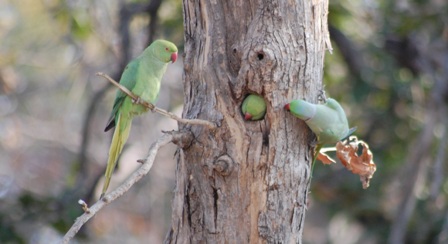
We watched these three rose ringed parakeets (above) playing hide and seek. It appeared as if the two outside was feeding the one inside.

dsc_0141

Yellow footed green pegion (above)

dsc_0152

The bar-headed goose (above) is one of the world’s highest flying birds, flying over 30,000 feet. It migrates to India to spend the winter.

dsc_0170

dsc_02041

We spotted a good number of birds, and Shravan our guide being a bird enthusiast helped us.

Atul Dhamankar, a wild life enthusiast and avid bird watcher who is based out of Chandrapur has published a very informative book on the birds and mammals of Tadoba. We picked a copy of it from the guide and came handy while identifying birds.


3 responses so far

Oct 24 2009

Off season beauty @ Mahabaleshwar

Published by thecouple under Nature's Wonders,Places

Mahabaleshwar. Just as the rain recedes. The last few days of whispering between clouds and the hills.

mh_off1

mh_off2

mh_off3

mh_off4

mh_off5

mh_off6

mh_off7

mh_off8

mh_off9

mh_off10

3 responses so far

Oct 20 2009

MTDC – Budget traveller’s delight

Published by thecouple under Nature's Wonders,Places

In the past three years or so, we have visited a few places in Maharashtra. One thing that has been common in many of these visits was MTDC ( Maharashtra Tourism Development Corporation) resorts that offer reasonable boarding and lodging. We have now become a fan of MTDC resorts albeit it’s difficult to get accommodation without advance booking.

Mahabaleshwar

(Mahabaleshwar)

MTDC is present in most of the important tourist places in Maharashtra. Simple and basic accommodation. Clean toilets. No fancy stuff. Will fit any backpackers / travel lovers’ budget. Some of these resorts are leased out to private contractors, who have to pay a certain rent for the building and a share of revenue. In some cases, only the restaurants are contracted out.

Mahabaleshwar

(Mahabaleshwar)

But food certainly is not a gourmet’s delight. If you are a foodie and would like to give an equal weightage to the food experience, MTDC might not satisfy you always.

As a first mover, MTDC’s resorts occupy the prime locations in these places.

MTDC resort at Mahabaleswhar is in a sprawling estate with accommodations of various types.

Lonar

(Lonar)

The resort at Lonar, (the only lodging place in Lonar) overlooks the crater. This resort is fairly new.

Ajanta has two resorts – one of the luxury type and the other, a basic one.

Raigad has many old-style cottages, but recently renovated.

Harihareshwar

(Harihareshwar)

Harihareshwar resort is set very close to the beach, flanked by beach almost on two sides and a hillock on the third side. Almost all the rooms are cottages and pretty cool.

The resort at Koyna Nagar offers beautiful view of the Koyna lake from top.

Bordi

(Bordi)

Bordi resort opens to the beach itself.

Pench (Nagpur) is now privatized, but still offers the MTDC comforts and is the only accommodation available at Pench, Maharashtra.

Pench (Sillari)

(Pench-Sillari)

Amboli resort borders the forest

More after we visit the remaining ones.

6 responses so far

Jun 21 2009

Where Mowgli roamed

As the dawn was breaking the Sambhur belled
Once, twice and again!
And a doe leaped up and a doe leaped up
From the pond in the wood where the wild deer sup.

- The Jungle Books, Rudyard Kipling

Every morning, Mowgly and his friends perhaps would have woken up to this scene. We too were hoping for the same.

peacko

The early morning drive from the Maharashtra side of Pench Tiger Reserve to the Madhya Pradesh side of Pench was filled with expectations. Never mind the rattling of the old Toyota Qualis and the chilly wind. We had to cover the 50 odd km and reach the Thuria Gate at MP before the safari counter opened. We stayed at the Sillari MTDC resort on the Maharashtra side.

dsc_01401

Pench Tiger Reserve is spread across two states with Maharashtra having a share of about 20% of the total area. Maharashtra government declared the area as a wild life sanctuary much later than the one in MP was formed. While we planned the trip, we did not have a clear understanding of geography and options available. So we decided to have Sillari as the base, do the safari, and keep a day and half for experimentation/exploration.

dsc_0205

Sillari is a tiny village in the outskirts of the sanctuary, though one has to pass through the jungle to reach there. MTDC resort, as usual did not disappoint us. With the help of resort staff and some locals, we figured out that on the same day we could do an evening safari in the Maharashtra forests and give the MP side a shot the next day. If we could reach the MP gate before 6 in the morning, there was a good chance of doing a safari.

dsc_0306

In the evening, we hired the only Maruti Gypsy available at the resort and headed to the forest. Leopards and tigers remained elusive. We had to whet our appetite with Indian gaurs, deers, sambhars, wild dogs, and a variety of birds including peacocks. The wild life sanctuary also included the Meghdoot reservoir and the catchment area. The old watchman near the dam shared the stories of massive work involved during the making of the dam, the landslides, the accident deaths and more. Dams have always fascinated us. It has always been a mixture of fear, awe and surprise. We also did some exploration on one of the tributaries of Pench, which had some interesting rock formations.

dsc_0323

dsc_0292

The MP side was five times as big and much denser. By 6 am, there were over 30 open jeeps filled with wildlife enthusiasts lined up at the gate of The Indira Gandhi National Park (as it is called). We joined them.

dsc_0410

Shivering, we started the jungle safari, but soon got warmed up by the sight of many birds and animals. More than that we spotted during the previous day’s safari at Sillari. The vast expense of forest meant that the safari was over 5 hours long. In that delightful 5 hours, we forgot about hunger and breakfast. Despite some wild chase based on the alarm calls by deers, we could not spot the majestic tiger. We left Pench after just seeing the scratch marks on a tree, where a tiger sharpened its nails or marked its territory.

If only we could meet Shere Khan’s successors …

More photos on Pench (Maharashtra) and Pench (Madhyapradesh)

Sillari is about 110 kms from Nagpur. Sillari has an MTDC resort. Thuria gate, which is on the Madhyapradesh side is about 150+km from Nagpur. There are many private resorts on the Madhyapradesh side.

8 responses so far

May 04 2009

After the Divine tree, now a Sexy tree

Published by thecouple under Nature's Wonders,Places

After the Divine tree darshan, let us take you to this tree we came across at Pench National Park. This is not the first time we are seeing a Ghost Tree. But something that can let your imagination fly – is the first time.

pench-tree2

Ghost tree is called so because its bark gives a ghostly appearance in moonlight. Ghost trees are often found in the Sahyadris. Known as Sterculia Urens by its biological name, and as Gulur, Kadaya, Karaya etc in Hindi, this is cultivated in some parts of northern India for its gum.

pench-tree1

These trees grow in dry deciduous forests and occupy hilltops, exposed ridges, rocky crevices, eroded slopes etc. Is very resistant to drought and will grow on dry stony soils.

Place: Pench National Park. PNP is spread across Maharashtra and Madhyapradesh. This was at the Madhyapradesh side. About 110 kms from Nagpur

6 responses so far

Jan 01 2009

Old Fears Die Hard

Published by thecouple under Nature's Wonders,Places

The surprise element in the three-day Ratnagiri mountaineering camp organised by Nature Knights was the ‘Snake familiarisation’ session by the Ratnadurg Mountaineers. For some of us, it was a pleasant surprise while for others it was perhaps a dreadful one.

snake garland

A bagful of snakes. All captured/rescued from the human habitat around Ratnagiri town, and ready to be let out to the forests. The session was to make us, the city folks, to understand and appreciate the ‘other’ friends around us. There were a few varieties of them. Some of us touched them, felt them, and almost all of us allowed the rat snake to coil around our necks. Some of the smaller ones  remained agile and ready to attack while they found their way through the many nimble figures and some muscle-flexing arms. It was mixed feelings for many. Fear, awe, excitement, shock… something unimaginable. All of a 12×10 room. Over 20 people. And about 6 snakes wondering where on earth are they!

‘She’ in thecouple was certainly fearless. ‘He’ said that he was busy clicking the photos and did not get time to try it. But you get the truth. Old fears die hard. :-)

7 responses so far

Nov 09 2008

Dandeli: Syntheri Rocks

Published by thecouple under Nature's Wonders,Places

There is a warning board which says ’12 dead till now. Please do not add to it’. And there is a lone watchman by its side  – Lost in his thoughts and bidding time looking at the ferociously flowing water deep down. Deep inside the jungle, in the middle of nowhere.

.Syntheri Board

Syntheri is a good 30-km drive from Dandeli town. The narrow and pot-holed roads meandering through the forests rarely have sun rays touching the ground even on sunny days. Apart from langurs and monkeys, all we saw were a couple of snakes crossing the road. But trampled bamboos along the road suggested that mighty pachyderms had fun last night.

rock

Syntheri Rocks is a huge 300-ft tall monolithic stone deep inside the jungle. The Kaneri River gushes fast and furious by the side. The rocks are chiseled fine with flowing water over the years, as if it is done meticulously on lathes.

rock carve

The forest department has done some interesting informative work here: sort of a rock museum. Different kinds of rocks are installed along the pathway with an explanation on each. Tastefully done.

The Photostory is here

One response so far

Aug 11 2008

A motley crowd and a mighty mountain

Published by thecouple under Nature's Wonders,Places

A Sunday morning. A motley crowd in their 20s to 40s. A mighty mountain – Gorakhgad.

We cribbed about the hot sun and the lack of rain only to realise later that descending would’ve been difficult had it rained. The wind at the top was strong enough to blow one away. One of us was reluctant to remove her backpack fearing she might lose her balance. Climbing down was a little hard at a few points especially for the first-time trekkers. Sliding down was the choice of many. But as usual Nature Knights pulled it off.

A dip in the stream at the base marked the end of this well-spent Sunday.

Click the Photo below to see the pictures from the trek …


Gorakhgad Cover

6 responses so far

Next »

  • Mitsubishi – The Great Driving Challenge

    Photobucket
  • ————————————————————————

  • Recent Posts

  • Recent Comments

  • Archives

  • Tags

    Adventure Beaches Bird Sanctuary Bordi Chiplun Dandeli Ecotourism English Fun Guhagar Harihareshwar Himalayas Homestay Kalaghoda Karnataka Kashmir Kerala Kollam Konkan Lonar Mahabaleshwar Maharashtra Malvan Mangalore MTDC Mumbai Nagpur Nashik Pune Ratnagiri Sahyadris Sanjay Gandhi National Park Saputara Shenkottai Sindhudurg Solapur Srinagar Tadoba TGDC the great driving challenge Trek Velneshwar Western Ghats Wildlife Wildlife Sanctuary
  • Categories

  • Nature Blog Network
  • Photobucket
  • IndiBlogger - Where Indian Blogs Meet Blog Flux Directory

    Travel blogs