Archive for the 'Birdwatching' Category

May 02 2010

Mumbai winter visitors turn pink

By this time, they would’ve already set off to Kutch or getting ready for the journey. When we met them in December, they were busy feeding on the algae in the Sewri mudflats.

dsc_0091dsc_0135

Flamingos migrate to Maharashtra during winter after spending the breeding season in Kutch, Gujarat. Sewri, a port area in Mumbai, is one of their favourite hangouts. How did they choose to come to this derelict area?  Maybe, the rich algae found in the muddy tracts that get exposed during low tides. Feeding on these algae that have a carotenoid pigment, these migratory birds turn rich pink by the time they are ready to move to Kutch for breeding.

dsc_0178

dsc_0192

We reached Sewri in the morning during high tide. We could see a large flock floating in the water. As time passed, thousands more joined the gang. Asif from Nature Knights led us to a shaded spot on a barge that was being built. We would’ve got terribly tired waiting till noon in the hot sun and would not have stayed for long. Spreading our plastic sheet, we sat there with our cameras, binoculars, water, and snacks.

dsc_0197

dsc_0205

Slowly, as the tide started receding, the birds moved closer to us. By around 12, they were just below us rubbing their beaks in the mud and filtering out algae from the water using the tiny hairs that line the inside of their bills. We watched them in awe in utter silence for some time, when a boisterous group of people scared them. As they took flight, we cursed the noisy group and wound up the birding session organised by Nature Knights.

dsc_0219

dsc_0247

The effluents from the chemical and oil companies around Sewri have reportedly been polluting the water in this area. And this polluted water produces the algae, which is a staple food for flamingos. Isn’t it a bit of contradiction? Conservation supported by pollution! However, studies reveal that the chemical content of the water has been steadily rising and it could be harmful to the flamingos in the long run.

dsc_0253

dsc_0264

Two types of flamingos come to Sewri—lesser flamingos in large numbers and greater flamingos in small numbers. Size alone differentiates them. Flamingos are grey when they are born and turn white as they become juveniles. The adults, as they get ready to breed, gradually turn pink.

dsc_0318

Check out the tide time table here and plan your visit accordingly.

3 responses so far

Mar 09 2010

Birds of Tadoba

Tadoba has a rich bird life with over 160 varities either  residing or visiting seasonally. The main lake in the middle and couple of other lakes mean that there are a fair amount of water birds as well – Cormorants, herons, ibis, storks, varieties of ducks, bar-headed goose, buzzards, eagles, quails, purple swamphens, bronze winged jacana, lapwigs, common redshank, common and wood sandpipers and many more…

dsc_0053

dsc_0081

A little cormorant by the side of the Tadoba lake (above)

dsc_0084

The red-wattled lapwig (above)

dsc_0094

Black Ibis (above)

dsc_0108

dsc_0112

Green bee eater (above)

dsc_0131

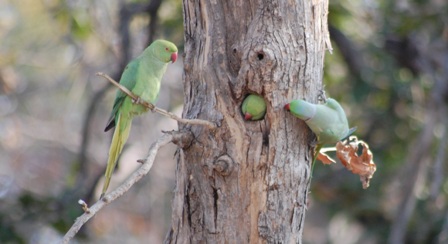
We watched these three rose ringed parakeets (above) playing hide and seek. It appeared as if the two outside was feeding the one inside.

dsc_0141

Yellow footed green pegion (above)

dsc_0152

The bar-headed goose (above) is one of the world’s highest flying birds, flying over 30,000 feet. It migrates to India to spend the winter.

dsc_0170

dsc_02041

We spotted a good number of birds, and Shravan our guide being a bird enthusiast helped us.

Atul Dhamankar, a wild life enthusiast and avid bird watcher who is based out of Chandrapur has published a very informative book on the birds and mammals of Tadoba. We picked a copy of it from the guide and came handy while identifying birds.


3 responses so far

Feb 14 2010

Birding at Uran

Published by thecouple under Birdwatching

Most often, one misses the simple pleasures and beauties near home.

We knew Uran had something to offer for bird watchers, but had never ventured.

So in one of our short treks to Vyagreshwar, Nature Knights decided to pack in an early morning birding. And it was worth it.

img_2483

Ibises, coots, whistling ducks, bee eaters and many more unnamed birds gave us company 0n a winter morning.

img_2484

img_2497

img_2502


No responses yet

Oct 31 2009

Birding at Nannaj grasslands

The Great Indian Bustard didn’t reveal itself to us. But our birding experience at Nannaj Bird Sanctuary wasn’t disappointing. We spotted many other birds (don’t ask for names, though we went there armed with A Field Guide to the Birds of India) and as a bonus, saw two wolves chasing blackbucks.

twac_01

Nannaj Bird Sanctuary, officially called as Maldhok Bird Sanctuary or GIB Bird Sanctuary, is at 25-odd km from Solapur, Maharashtra. It is home to the endangered Great Indian Bustard (GIB) and is one of the few places where it is still spotted. Nannaj was declared a bird sanctuary in 1979 to protect GIB (Maldhok in Marathi).

twac-02

This vast grassland also welcomes a few migratory birds, though we didn’t spot any as it was not the season. The road from Solapur to Nannaj is bordered by grasslands for a few kilometers. We got glimpses of several birds on these tracts as well. The sanctuary has a good population of black bucks and we watched a few herds going about their daily lives.

twac_03

Unlike other bird sanctuaries, you are not allowed to move around freely in the core area of Nannaj. At a 100-odd meters from the gate, there is a hut (brick-work structure) with peep holes and fitted with benches and desks for observing and capturing the life outside. You are not permitted to go beyond this hut. This space provides a perfect hiding place to observe birds and animals without disturbing their peace. There is also a watch tower near the gate.

twac_05

Since we went there during Diwali, the watch tower and the hut were locked. The forest guards were not around. To our luck, we met an avid bird watcher and wildlife enthusiast, Vishal Jadhav from Pune. Being a regular visitor, he had managed to get the key to the hut from the forest department the previous day. We joined him in the hut and got a lot of information about Nannaj’s wildlife and some photography tips from him. Thanks Vishal, for your friendly gestures.

twac_04

We went to the sanctuary thrice. On the last day, we spotted two wolves chasing blackbucks. We waited for some time for the drama to unfold, but had to leave as it was getting late to start our journey back to Mumbai.

twac_07

The only stay option near the sanctuary is the forest rest house. It’s hard to get accommodation there as you have to get permission from Pune Forest Office. Nearest teashops and restaurants are one kilometer away in Nannaj village. If you want to spend a few hours in the sanctuary, stock up enough water and snacks. We stayed in a hotel in Solapur and drove to Nannaj thrice.

[HTML4]

Nannaj is 25 kms from Solapur (Maharashtra)on the Solapur-Barshi road. Solapur is 404 kms from Mumbai via Pune

6 responses so far

Jun 21 2009

Where Mowgli roamed

As the dawn was breaking the Sambhur belled
Once, twice and again!
And a doe leaped up and a doe leaped up
From the pond in the wood where the wild deer sup.

- The Jungle Books, Rudyard Kipling

Every morning, Mowgly and his friends perhaps would have woken up to this scene. We too were hoping for the same.

peacko

The early morning drive from the Maharashtra side of Pench Tiger Reserve to the Madhya Pradesh side of Pench was filled with expectations. Never mind the rattling of the old Toyota Qualis and the chilly wind. We had to cover the 50 odd km and reach the Thuria Gate at MP before the safari counter opened. We stayed at the Sillari MTDC resort on the Maharashtra side.

dsc_01401

Pench Tiger Reserve is spread across two states with Maharashtra having a share of about 20% of the total area. Maharashtra government declared the area as a wild life sanctuary much later than the one in MP was formed. While we planned the trip, we did not have a clear understanding of geography and options available. So we decided to have Sillari as the base, do the safari, and keep a day and half for experimentation/exploration.

dsc_0205

Sillari is a tiny village in the outskirts of the sanctuary, though one has to pass through the jungle to reach there. MTDC resort, as usual did not disappoint us. With the help of resort staff and some locals, we figured out that on the same day we could do an evening safari in the Maharashtra forests and give the MP side a shot the next day. If we could reach the MP gate before 6 in the morning, there was a good chance of doing a safari.

dsc_0306

In the evening, we hired the only Maruti Gypsy available at the resort and headed to the forest. Leopards and tigers remained elusive. We had to whet our appetite with Indian gaurs, deers, sambhars, wild dogs, and a variety of birds including peacocks. The wild life sanctuary also included the Meghdoot reservoir and the catchment area. The old watchman near the dam shared the stories of massive work involved during the making of the dam, the landslides, the accident deaths and more. Dams have always fascinated us. It has always been a mixture of fear, awe and surprise. We also did some exploration on one of the tributaries of Pench, which had some interesting rock formations.

dsc_0323

dsc_0292

The MP side was five times as big and much denser. By 6 am, there were over 30 open jeeps filled with wildlife enthusiasts lined up at the gate of The Indira Gandhi National Park (as it is called). We joined them.

dsc_0410

Shivering, we started the jungle safari, but soon got warmed up by the sight of many birds and animals. More than that we spotted during the previous day’s safari at Sillari. The vast expense of forest meant that the safari was over 5 hours long. In that delightful 5 hours, we forgot about hunger and breakfast. Despite some wild chase based on the alarm calls by deers, we could not spot the majestic tiger. We left Pench after just seeing the scratch marks on a tree, where a tiger sharpened its nails or marked its territory.

If only we could meet Shere Khan’s successors …

More photos on Pench (Maharashtra) and Pench (Madhyapradesh)

Sillari is about 110 kms from Nagpur. Sillari has an MTDC resort. Thuria gate, which is on the Madhyapradesh side is about 150+km from Nagpur. There are many private resorts on the Madhyapradesh side.

8 responses so far

Jun 15 2009

Karnala revisited

Published by thecouple under Birdwatching,Places

One of our early treks was to Karnala. Karnala, with its thump-shaped pinnacle on its top cant be missed when you take the Mumbai-Goa highway. An easy climb. Till the pinnacle. Conquering the pinnacle calls for technical rock climbing.

dsc_0024

The trek is more interesting as it is through the Karnala Bird Sanctuary. If you can combine early morning, keen eyes, and luck, you will spot many winged creatures. In our first trip we spotted a crested serpent eagle and an owl.

dsc_0075

This time, on May 1, we decided to celebrate Maharashtra Day by taking an early morning hike through the sanctuary looking for some birds. Karnala itself has changed a bit. The forest department had put up a board depicting the birding trails, which was very helpful for us. We explored the longest trail.

dsc_0038

The leafless trees against the backdrop of blue sky offered some frames for the camera. En-route we got two knowledgeable and avid bird watchers – a father & daughter – for our company.

Birds, we spotted. But also an unfair share of plastic waste strewn across the forest. Soon we started picking up the bottles, cups, carry bags, the works.

dsc_0050

Maybe, as a token of appreciation, nature let us spot a rare-to-see bird – Shama.

Half-a-day well spent.

Karnala bird sanctuary is about 61 kms from Mumbai, on the Mumbai-Goa highway. See more photos here

2 responses so far

Mar 11 2009

Nandur-Madhyameshwar: Maharashtra’s own Bharatpur

Among the few books (other than a whole bunch of maps and road atlas) that we use as travel guides, there is one called ‘Offbeat tracks in Maharashtra’. Written by Milind Gunaji, a Marathi actor and photographer, this is an interesting and handy book when one wants to do the ‘non-touristy’ travel. We take tips and pointers from it and mix our own ‘de-tours’ to get some interesting variants every time.

nandur1

Nandur–Madhyameshwar was one such find. Being somewhere closer to Nasik, we put this in our Nasik itinerary. Nandur–Madhyameshwar is popular only among avid birders and is known was Maharashtra’s own Bharatpur. Rightly so!

nandur2

nandur3

The sanctuary is named after the ancient Madhyameshwar temple. There is a dam built on the confluence of the Godavari and the Kadva rivers, and the backwaters of the reservoir forms a perfect playground for migratory birds. Storks, sandpipers, egrets & brahmani ducks we could identify. And a host of other birds, which we couldn’t name but watch and appreciate.

nandur4

The main road runs parallel to the river for a few kilometres. At a few places, one could take detour to the river bank at about 500 metres through paddy fields. Forest department has erected watch towers at these points, which offer breathtaking views and more birds.

nandur5

Nandur is about 50 km from Nasik. The irrigation department has a guest house near the dam, where one can stay with prior permission. Own conveyance is the best option to reach Nandur since the state transport bus service is restricted to just two trips a day.

nandur6

7 responses so far

  • Mitsubishi – The Great Driving Challenge

    Photobucket
  • ————————————————————————

  • Recent Posts

  • Recent Comments

  • Archives

  • Tags

    Adventure Beaches Bird Sanctuary Bordi Chiplun Dandeli Ecotourism English Fun Guhagar Harihareshwar Himalayas Homestay Kalaghoda Karnataka Kashmir Kerala Kollam Konkan Lonar Mahabaleshwar Maharashtra Malvan Mangalore MTDC Mumbai Nagpur Nashik Pune Ratnagiri Sahyadris Sanjay Gandhi National Park Saputara Shenkottai Sindhudurg Solapur Srinagar Tadoba TGDC the great driving challenge Trek Velneshwar Western Ghats Wildlife Wildlife Sanctuary
  • Categories

  • Nature Blog Network
  • Photobucket
  • IndiBlogger - Where Indian Blogs Meet Blog Flux Directory

    Travel blogs