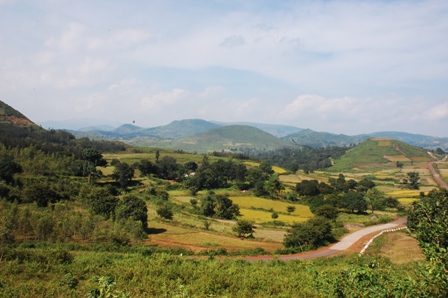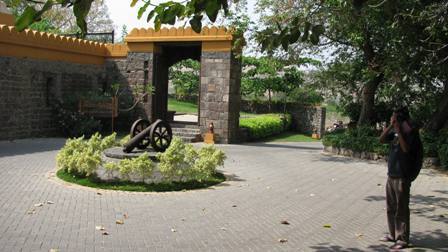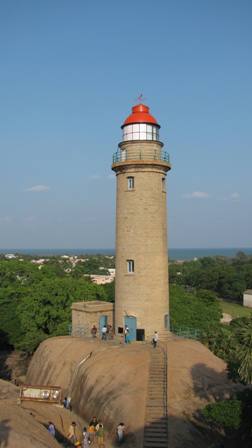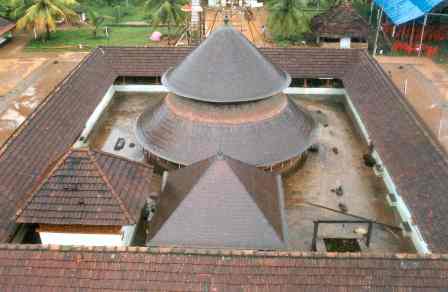
As we approach the entrance, the doorman ceremoniously lifts the bugle and plays. A little embarrassed, we enter the fort. More welcome ceremonies follow. A lady applies sandal paste on our foreheads while a gentleman waits with perfumed towels.
Located at about 20-odd km from Pune, off the Pune-Saswad road, this fort-converted-hotel is run by the Orchid Group. An eighteenth century fort built by Pilaji Jadhavrao (a famous general of in the army of Chatrapathi Shahuji, grandson of Chatrapathi Shivaji), Jadhavgad is small and less splendorous compared to other Maratha forts. But it has a quaint charm and the redevelopment is done in a way that retains and accentuates this. The original fort had only one building and an outer wall. Deluxe rooms and suites built along the wall gives a feeling that we are indeed in a fort. The royal bedroom is now the royal suite. Royal tents that dot the campus suit those who prefer a little bit of outdoor experience.
This resort is also considered as world’s first museum hotel. A museum named Aai (mother in Marathi) displays rare, historic items from the personal collection of Mr Kamat who owns the Orchid Group. An interesting visit. Photography is not allowed inside the museum.
Chajja, the multi-cuisine restaurant offers a fine spread. Small eaters we are, we couldn’t give justice to the buffet lunch. But whatever we stuffed ourselves with was excellent. Another dining option is the open-air restaurant Payatha that serves traditional Maharashtrian fare.
[HTML7]
A tour of the Fort will make your pocket lighter by Rs 500. But this can be adjusted against the restaurant bill. The lunch buffet at Chajja was Rs 650 plus taxes (without alcohol).
The descendants of Chatrapathi Shahuji live close by and the Orchid Group has taken the Fort on a 99-year lease. And they’ve done a good job in preserving it.
Most of us have grown up with the philosophy of seeing God in everything – in every stone, every tree, every human being, every animal and what not. Roadside temples are not anything new in India. We have earlier written about a tree with a slight resemblance to an elephant’s trunk turning into Ganpathi idol and a street side temple. (Of Faith & Creativity).
This is another interesting version. A huge rock in the Matheran hills turning into another massive Ganpathi. Clever use of colours and artistic rendering have converted this huge rock into a divine statue complete with a mouse at its feet.
This interesting piece of art is visible during the train ride from Neral to Matheran. The trekking route from Peb Fort to Matheran also passes through this new temple.
Kanchipuram – Mahabalipuram (Mamallapuram) is barely 70 kms and is connected by good roads. Not a wise idea to combine both these places on the same day as you are unlikely to do justice to both the places.
Mamallapuram is a 7th century port city built by Pallavas and is supposeed to be named after the Pallava King, Mamalla. Mamallapuram is classified as UNESCO World Heritage site. With some of the rock cut temples resembling the Buddhist/Jain architecture, it is believed that the Pallava kings bought artisans and sulptors from central India after they won over the Chalukyas.
We unfortunately missed the most important site – The shore temple, which was closed by the time we reached. We had to limit our explorations around the rock cut temples. The annual Mamallapuram Dance Festival was on we caught a glimpse of some folk dance.
Mamallapuram is on the Chennai – Pondicherry East Cost highway (ECR) and connectivity is not an issue. Tamilnadu has one of the best bus network in the country and the deal just got better with the introduction of new Volvo city buses connecting Mamallapuram with Chennai city.
The year 2009 ended on a good note with a packed weekend. We were back to Chennai after 5 years for a family get together. But we did manage to plug-in an active one-day travel.
It is a matter of shame that we lived in Chennai for 7 years and not even once we visited Kanchipuram or Mahabalipuram. We were not in our elements then for sure.
So it was Kanchipuram and Mahabalipuram. We planned the timings so that we will be at Kanchipuram Saravana Bhavan for breakfast.
Kanchipuram is known as the city of temples and is one of India’s seven sacred cities, second holiest after Varanasi. The temples were built by different dynasties as the city changed hands. The Pallavas from 6th to 8th century AD, followed by Cholas and the Vijay Nagar kings. Kanchipuram is also unique in the sense that it is a seat of the two sects of Hinduism – Vaishnavism and Saivism. The Varadaraja Perumal temple is a centre for Vaishnavism, the Ekambaranathar temple is a Saiva centre, with the Kamakshi Amman temple tucked in between.
It requires a minimum of one full day to explore Kanchipuram completely. And yet again – at one more place, we made a promise – to come back.
Solapur was once a bustling textile town. The Solapur chadder is famous even now, though the number of mills has dwindled and many of the looms have moved out of the town.
We wanted to visit one of those looms and speak to a few people and made our enquries, but only to realise that there are only show rooms and not any mills/looms around the town. So we were directed to the largest and the most popular one – Pulgam Textiles. We were not disappointed for there were some unique cotton bedsheets. The chadder certainly has its charm, going by the crowd thronging the shop, spread across three large buildings. The salesmen were friendly and had a knack of selling. And, we ended up buying a few.
Solapur chadder once got the fashion world sit up and take notice. James Ferreira, a Mumbai based fashion designer featured a fashion range at the Lakme Fashion Week 2006 and the models walked the ramp wrapped in Solapur chadder.(Photos from Sify)
It’s already jingle bells time at the ITC Grand Central! Last week was the ‘cake mixing ceremony’ – mixing loads of dry fruits with spices, honey, and fruit extracts. The mix is let to ferment for a month or so, for baking those delicious plum cakes for Christmas.
This year, the students of Akanksha Lower Parel Centre were invited for the cake mixing ceremony at the ITC Grand Central, Parel, Mumbai. Saroj maestro Ustad Amjad Ali Khan and his sons were the celebrity guests for the event.The kids were so thrilled and charged up that they managed to convince their teachers to allow them to leave early from school. They were restless even while watching cartoons during the short wait time.
The excitement was palpable as they got ready for the ceremony in the ball room. As about 30 kids got into the act, wearing Christmas caps and palms duly tucked in gloves, the room soon got filled with a heady aroma of fruits and spices. The colourful mixture and the sweet aroma was enough to give an idea about how yummy the cake would be! The exhilaration soared as the kids fished out the two hidden coins from the mix.
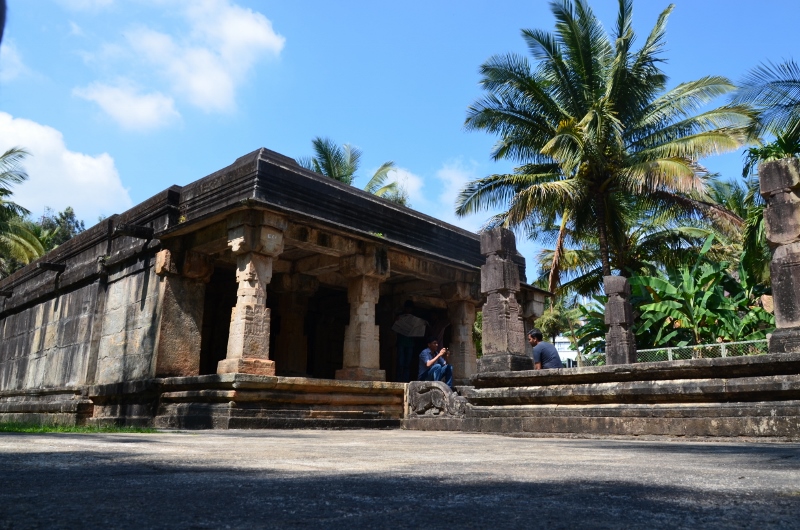
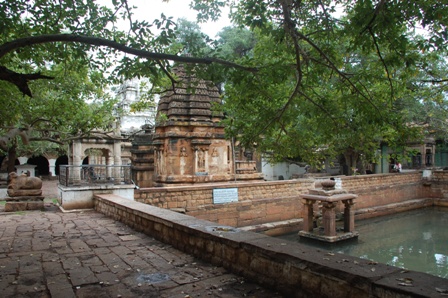
One of the stories from our TGDC trail was about our search for old Jain temples in Wayanad in Kerala. There are a few of them, either taken over by ASI or left to crumble, like the one we managed to visit.
After visiting the place and reading a little more about Jain temples in Kerala, a realisation dawned on us – Most temples in Kerala were earlier Jain or Buddhist temples. We had earlier read that the famous Sabarimala temple (with close to 5 crore visitors a year, it is supposed to be the second biggest annual pilgrimage after Mecca) was originally a Jain temple.
Jainism and Buddhism came to Kerala as early as 200 or 300 AD and flourished till 1000 AD. The arrival of Vedic brahmins to Kerala from 800 AD and the royal patronage they got, resulted in many of these shrines getting converted into Hindu temples. The massive Vadakkumnatha temple in the heart of Thrissur city was once a Buddhist temple. The Koodalmanikyam temple in Irinjalakkuda was a Jain temple.
It is said that all temples that are in circular shape were Buddhist temples and all those are in square shape were Jain temples.
(photo courtesy: from the website http://www.thrikodithanam.org)
At one level, on hindsight, the ‘Search’ per se had no meaning. Because we grew up around those very same Jain and Buddhist temples!
The arrival of Vedic brahmins led to some radical changes in Kerala society, one of them being the rigid case system. The historical bits made an interesting read. Many stories we had heard as kids have larger and different stories behind it. While searching for information on Jain temples, we also ended up discovering some interesting and informational websites and blogs.
Check out these: http://historicalleys.blogspot.com written by Mr Manmadhan, based in California – extensively researched and exhaustive.
http://www.thrikodithanam.org/intro.htm– a website about a particular temple in Kerala and some interesting history. (some of the information in this entry is sourced from this website)
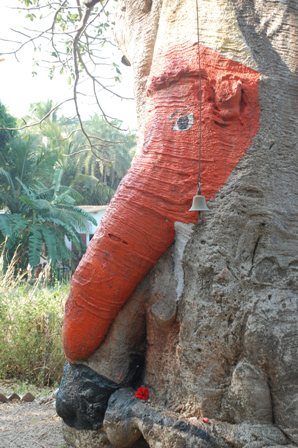
With countless number of Gods & Goddesses (83 million by someone’s estimates or 830 million?), roadside stones and trees turning to temples is not new in India. There is no rural-urban divide in these phenomena. All that matters is faith.
This interesting tree apparently has a mild resemblance to Lord Ganesha’s trunk. It is clear that the clever and creative painting is what brings it live. Nevertheless, the Ganesha tree has already started attracting attention of travellers and is listed in the ‘must-see’ places in and around Bordi.
We saw this in the Bordi-Asavali road, about 2 km from the MTDC resort at Bordi.
Place: Bordi in Maharashtra. Bordi is on the North Konkan coast, at about 180 kms from Mumbai towards Gujarat.
While Shankar-Ehsaan-Loy weaved magic with their vocal chords, guitar strings and drums, the façade of Asiatic library had its own way of being the part of the magic. Two smart guys (they were introduced at the podium, but we forgot their names) behind the stage (in fact perched at the top) were managing this extraordinary show. Various colourful patterns were projected on the wall. Our national flag and flags of other countries, heart symbol saluting the Valentine’s Day, and a variety of images were simply beautiful.
Someone wrote in a travel note recently that “as you climb the curving stone steps towards the reception of the Asiatic Society library you feel you are ascending into loftier, ethereal regions”. We have not been to the inside of the library. But ascending to another world – yes, sometimes it is possible. Especially when the steps turn into an amphitheatre to watch the captivating performance by some of the best talents from the world of music.
This time it was Shankar-Ehsaan-Loy trio. We wonder if the Asiatic steps ever acted host to so many people. When the steps could not take any more butts, the latecomers spilled over to the road. Soon, the road became houseful! (Is there a term ‘roadful’?) The evening’s music events started off with Raghav Sachar’s World Music Fusion. Raghav Sachar is a prodigy. By the age of 27, he mastered about 30 musical instruments!!
The momentum was building up. The bollywood numbers by Shilpa Rao added to the enthusiasm. When Shankar-Ehsaan-Loy made their appearance on the stage, the excitement was palpable. Soon Shankar’s stage presence infected the audience, who cheerfully clapped, swayed, and sang with him. Shankar certainly has this uncanny ability to carry the audience with him.
As Shankar weaved magic, he threw in a surprise as well. In the form of Farhan Akthar. And FA simply decided to Rock On! ‘Standing ovation’ is a mild term to say about what followed next.
We have seen that this blog on Internet Explorer is not well presented as the layout is getting jumbled. Also the complete page is not getting loaded. This is best viewed in Firefox.
You can download Firefox here.